
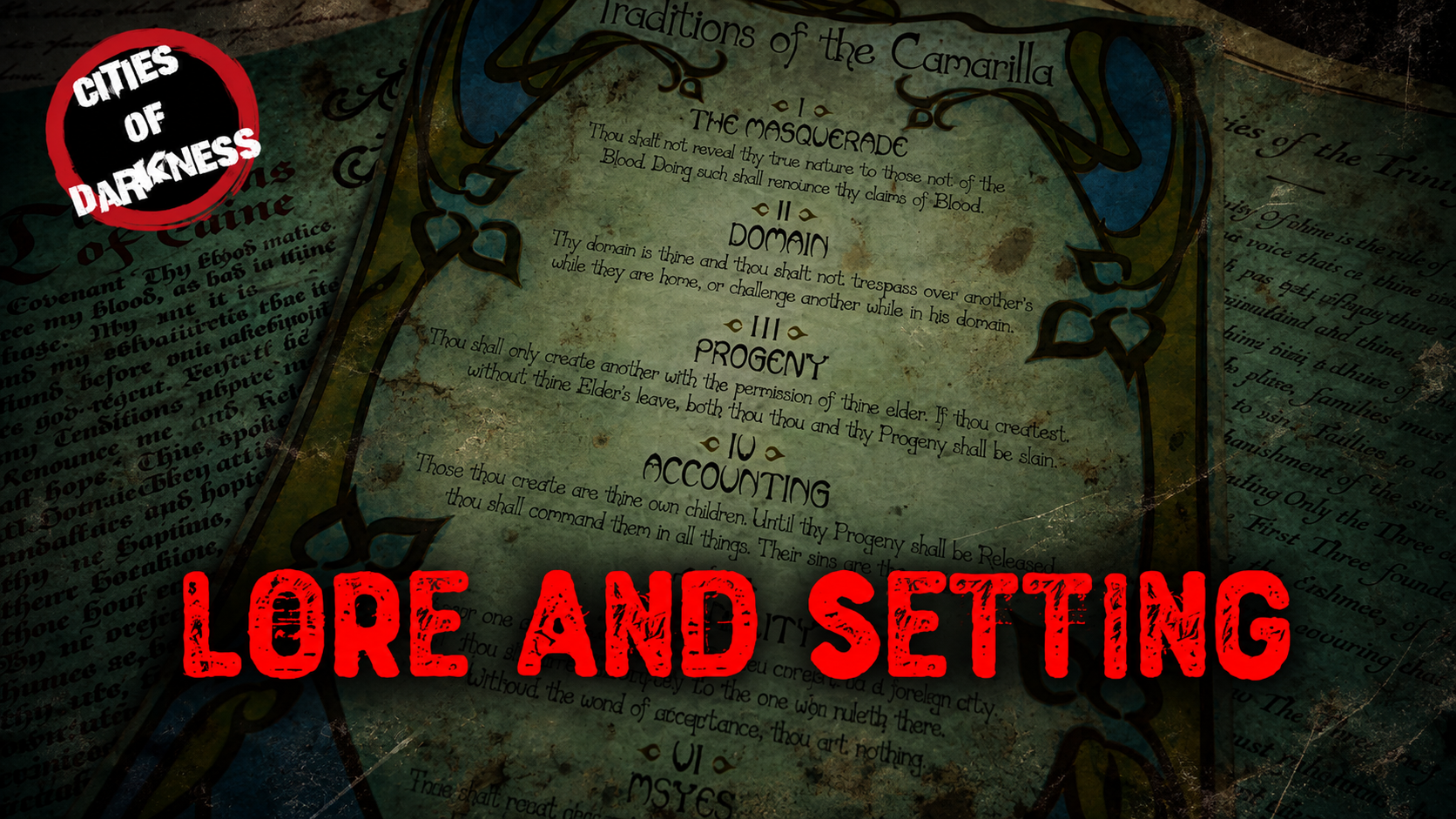
Your sire probably rattled these off like a list of house rules. Don't do this, don't do that, always do the other thing. Maybe they explained why. Maybe they just said "because I said so" and left you to figure out the rest.
Here's what they should have said: the Traditions are the only thing standing between you and a very short unlife. They aren't guidelines. They aren't suggestions. They are the laws of Kindred society, and the punishment for breaking them is not a fine or a stern talking-to. It's Final Death.
Every vampire, Camarilla or Anarch, acknowledges the Traditions in some form. The Camarilla treats them as sacred, codified law. The Anarchs argue about the details and reject the authority of those who enforce them, but even the most radical Baron will tell you the First Tradition is non-negotiable. The Traditions exist because without them, vampires die. Not individually. All of them.
Here's what each one actually means for you.
The First Tradition: The Masquerade
Thou shall not reveal thy true nature to those not of the Blood.
This is the one that matters most. Everything else is politics. This one is survival.
The Masquerade is the collective agreement among all Kindred that mortals must never learn that vampires exist. Not your mortal friends. Not your family. Not the bartender you feed from every Thursday. Nobody.
The reason is simple and it's not abstract. When mortals find out about vampires, they don't negotiate. They hunt. They've done it before. The Inquisition nearly wiped out Kindred society centuries ago, and the Second Inquisition is doing it again right now, with better technology and less superstition. Intelligence agencies, military black sites, surveillance networks. The mortals outnumber you by tens of thousands to one, and they have things that burn.
A Masquerade breach is anything that reveals the existence of vampires to mortals. Using Disciplines in public. Feeding carelessly. Leaving a body. Getting caught on camera with your fangs out. Posting something incriminating on social media. Letting a mortal you fed on remember what happened. Some breaches are dramatic. Most are small and stupid, a moment of carelessness that snowballs because you didn't clean up after yourself.
The consequences depend on who catches you. In a Camarilla domain, the Prince can call a blood hunt for a serious breach. Even a minor one can cost you Status, territory, or the goodwill of everyone who now has to help cover your mistake. In an Anarch domain, the Baron and the community will deal with it however they see fit, which can be just as harsh.
The Second Inquisition doesn't care about your faction. They care about patterns. One breach might go unnoticed. Two in the same area start a file. Three and someone shows up with questions you can't answer.
Your sire should have been blunt about this: the Masquerade is not about obedience. It's about the fact that if enough vampires get sloppy, everyone dies.
The Second Tradition: Domain
Thy domain is thine own concern. All others owe thee respect while in it. None may challenge thy word while in thy domain.
In practice, this Tradition establishes that whoever rules a domain has authority within it. For most vampires, that means the Prince or Baron of the city you're in has the final word on what happens there.
For you, as a fledgling, this Tradition means two things. First, you don't get to claim territory without permission. That block you like to hunt on? That building you're squatting in? Unless someone with authority has acknowledged your right to be there, you're trespassing on someone else's domain, and they're within their rights to do something about it.
Second, the ruler's word is law within their territory. You might disagree with the Prince's decisions. You might think the Baron is an idiot. But while you're standing in their domain, their authority is backed by the Traditions, and challenging it has consequences.
Domain disputes are one of the most common sources of conflict in Kindred society. Two vampires who both claim the same hunting ground. A Prince who grants territory to a loyalist at the expense of someone who's been there for decades. An Anarch who refuses to recognize the Camarilla's claim to a neighborhood. These disputes drive entire chronicles.
The Third Tradition: Progeny
Thou shall only Sire another with the permission of thine Elder. If thou createst another without thine Elder's leave, both thou and thy Progeny shall be slain.
You don't get to make more vampires whenever you feel like it.
In a Camarilla domain, creating a new vampire without the Prince's explicit permission is one of the most serious crimes you can commit. The Embrace isn't just a personal choice. Every new vampire is a potential Masquerade breach, a new mouth to feed in a territory with limited vessels, and a political liability for whoever created them. The Prince controls who gets to Embrace because unchecked creation threatens everyone.
The punishment described in the Tradition is exactly what it sounds like. An unauthorized Embrace can result in the destruction of both the sire and the childe. In practice, some Princes are more lenient than others, but even a lenient Prince will want to make an example. At minimum, you'll lose Status and owe debts you'll spend decades repaying.
Anarch domains handle this differently, but "differently" doesn't mean "freely." Most Barons still expect to be informed, if not asked. A new vampire appearing in the domain without warning is a problem regardless of faction politics.
If you were Embraced without permission, that's not your fault, but it is your problem. Your sire's transgression hangs over you until someone in authority decides to acknowledge your right to exist. Some fledglings spend their entire early unlife trying to earn legitimacy they should have been born with.
The Fourth Tradition: Accounting
Those thou create are thine own children. Until thy Progeny shall be Released, thou shall command them in all things. Their sins are thine to endure.
This one is about your sire, and it's about you if you ever create a childe of your own.
Until a new vampire is formally Released, their sire is responsible for everything they do. If an unreleased fledgling breaks the Masquerade, their sire answers for it. If they feed in the wrong territory, their sire pays the price. If they insult the Prince, their sire apologizes.
Release is the formal acknowledgment that a new vampire is ready to stand on their own in Kindred society. It's a significant moment, roughly equivalent to being declared a legal adult. Before Release, you exist under your sire's authority and protection. After Release, your mistakes are your own.
Some sires take this responsibility seriously and spend months or years training their childer before presenting them to the court. Others Embrace someone, give them a three-minute explanation of the rules, and push them out the door. The quality of your sire's mentorship has a direct impact on your chances of surviving your first year.
If your sire is absent, destroyed, or simply doesn't care, you're in a difficult position. An unreleased vampire without a sire to vouch for them is politically vulnerable. Finding a patron, someone willing to take on the responsibility of your Accounting, is one of the smartest things a fledgling in that situation can do.
The Fifth Tradition: Hospitality
Honor one another's domain. When thou comest to a foreign city, thou shall present thyself to the one who ruleth there. Without the word of acceptance, thou art nothing.
When you enter a new city, you announce yourself to whoever's in charge.
This sounds like a formality. It isn't. An unknown vampire in a domain is a threat until proven otherwise. They might be a spy. They might be fleeing a blood hunt. They might be an agent of the Second Inquisition. The Prince or Baron needs to know who's in their territory, and a vampire who sneaks in without presenting themselves is assumed to be hiding something.
Presentation usually involves appearing before the ruler or their designated representative and stating who you are, where you're from, and why you're there. It can be as simple as a brief introduction at court or as formal as a structured ceremony, depending on the domain.
What happens if you skip it? In a Camarilla city, you have no rights. No protection. No standing. You can be harassed, fed upon, or destroyed, and nobody is obligated to lift a finger on your behalf. The Fifth Tradition is explicit: without acceptance, you are nothing. In an Anarch domain, the consequences vary, but showing up unannounced in someone's territory without introducing yourself is disrespectful at best and dangerous at worst.
If your chronicle is part of the Cities of Darkness network, the Chronicle Map at citiesofdarkness.com shows you where other chronicles operate. Knowing where neighboring domains are and who runs them is basic survival information.
The Sixth Tradition: Destruction
Thou art forbidden to destroy another of thy kind. The right of destruction belongeth only to thine Elder. Only the eldest among thee shall call the Blood Hunt.
You don't get to kill other vampires.
That right belongs to the ruler of the domain. In a Camarilla city, only the Prince can authorize the destruction of a Kindred, usually through a blood hunt, a formal declaration that a specific vampire is to be destroyed on sight. A blood hunt is the most extreme punishment in Kindred society, and it's not called lightly. When it is called, every vampire in the domain is expected to participate. Sheltering the target is itself a crime.
For a fledgling, this Tradition means two things. First, no matter how much you hate someone, you can't just kill them. Destroying another Kindred without authorization makes you a murderer in the eyes of the Traditions, and the punishment is usually a blood hunt called against you. Self-defense is sometimes accepted as a mitigating factor, but "sometimes" is not a guarantee you want to bet your existence on.
Second, if someone more powerful than you decides you need to die, the Sixth Tradition is the only thing protecting you. Without it, elder vampires could destroy younger ones with impunity. The Tradition doesn't guarantee your safety, but it does mean that anyone who kills you without the Prince's blessing has committed a crime, and that crime has witnesses.
The Unwritten Rules
The six Traditions are the formal laws. But Kindred society runs on a layer of unwritten expectations beneath them, things your sire might or might not have mentioned.
Don't make waves your first year. A fledgling who immediately starts challenging established vampires, making demands, or pushing boundaries is a fledgling who makes enemies before they have allies. Watch. Listen. Learn who has power and why before you decide to contest it.
Boons are binding. When you accept a favor from another vampire, you owe them. The boon system is the social contract underneath the Traditions, and a vampire who doesn't honor their debts is a vampire nobody will deal with. Understand what you're agreeing to before you accept anything.
Elysium is sacred ground. Certain locations in every domain are designated as Elysium: neutral territory where violence is forbidden and political discussion happens. Breaking the peace of Elysium is one of the fastest ways to make yourself universally despised.
Your reputation is everything. In a society where you might exist for centuries, how other vampires perceive you matters more than almost anything else. A reputation for being trustworthy, competent, and useful opens doors. A reputation for being reckless, dishonest, or disrespectful closes them permanently.
Why This Matters at the Table
At a LARP, the Traditions aren't just background lore. They're the framework that every political interaction hangs on.
A character accused of a Masquerade breach faces a trial that can dominate an entire session. A dispute over domain becomes a negotiation involving half the court. An unauthorized Embrace creates a political crisis that ripples through the chronicle for months. A blood hunt is one of the most dramatic events a Storyteller can introduce.
The Traditions give players a shared set of rules to argue about, exploit, enforce, and break. They create stakes. When your character does something, the Traditions tell you what the consequences might be, and that tension between what you want to do and what the Traditions allow is where the best stories in Vampire LARP come from.
Your sire told you the rules. Whether you follow them, bend them, or break them and deal with the consequences is up to you.
Cities of Darkness is a fan-run chronicle network using Laws of the Night V5 by By Night Studios.
Cities of Darkness material is not official World of Darkness material. Portions of the materials are the copyrights and trademarks of Paradox Interactive AB, and are used with permission. All rights reserved. For more information please visit worldofdarkness.com.